
Advancing Ideas, Empowering Scientists, and Connecting Research
Supporting research programs that foster innovation, scientific talent, and global collaboration.
From Strategy to Discovery
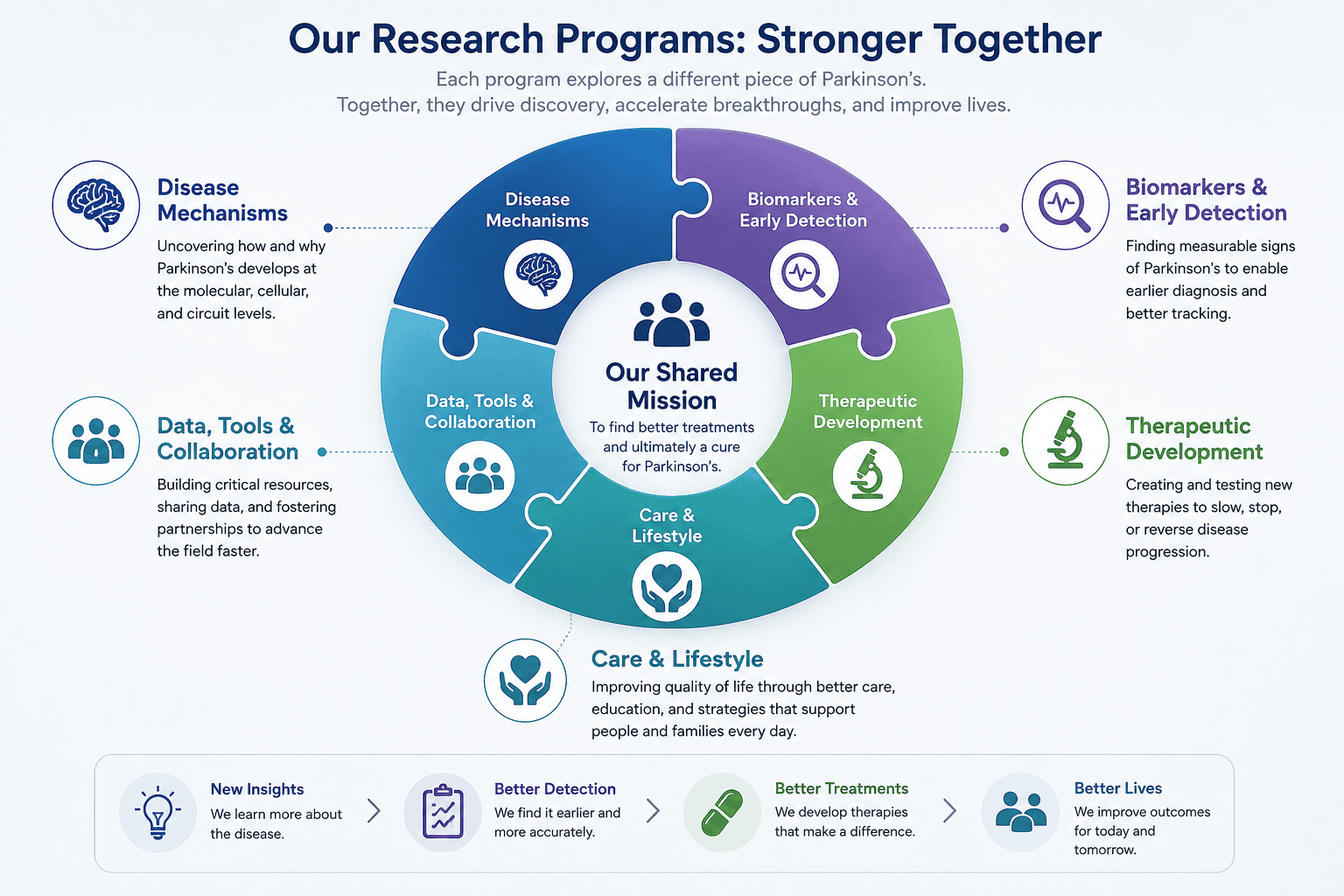
Our research programs translate our scientific strategy into focused action. They are designed to advance important research projects, give bold new ideas an opportunity to develop, and invest in talented scientists at decisive stages of their careers.
Across all programs, we support research into Parkinson’s disease and dementia with Lewy bodies, with particular emphasis on disease mechanisms, early detection, new therapies, and international scientific exchange.
Progress depends on strong ideas and exceptional people. That is why we support both innovative research projects and the scientists who can carry them forward.
Key Research Grant Program
This program supports rigorous, investigator-initiated research that can deepen our understanding of Parkinson’s and dementia with Lewy bodies or contribute to better diagnosis and treatment.
Funding may enable researchers to investigate disease mechanisms, validate biomarkers, identify therapeutic targets, or test promising treatment concepts. The program is open to postdoctoral researchers and established investigators and supports clearly defined projects with the potential to generate meaningful scientific or translational progress.
Key Features
Innovation Grant Program
Important discoveries often begin with an unconventional question, an unexpected observation, or a new technology that has not yet produced extensive preliminary data.
This program supports exploratory, higher-risk research with a strong scientific rationale. It can help researchers test feasibility, generate pilot data, establish new methods, and develop proof-of-concept findings that may form the basis for larger future projects.
Key Features
Transatlantic Postdoctoral Fellowship
The early postdoctoral years are a formative stage in a scientist’s career. This fellowship enables outstanding researchers who have recently completed their doctorate to spend a structured research period in a new laboratory in the United States or Germany.
Fellows can learn specialized methods, enter a leading international research environment, broaden their scientific perspective, and establish networks that may shape their future careers in Parkinson’s and dementia with Lewy bodies research.
Key Features
Transatlantic Investigator Award
This award supports outstanding early-career investigators who are ready to develop an independent research profile and progress toward scientific leadership.
Through protected career funding and substantial research experience in both the United States and Germany, awardees can access complementary expertise, infrastructure, and networks. The program aims to help researchers establish specialized Parkinson’s or dementia with Lewy bodies research groups and build sustainable transatlantic collaborations.
Key Features
A Connected Path From Ideas to Lasting Progress
Our programs are designed to complement one another.
An innovation grant can generate the first evidence needed for a larger research project. A postdoctoral fellowship can provide a young scientist with the methods and international network needed to develop an independent research direction. An investigator award can help transform that potential into a specialized research group with lasting impact. In this way, we support more than individual grants. We create pathways through which ideas, researchers, and collaborations can continue to grow.

Bringing the Right People and Ideas Together
Progress in Parkinson’s and dementia with Lewy bodies depends on access to the right expertise, technologies, models, and research environments. These resources are often distributed across institutions and countries.
Research Without Borders
International mobility is therefore central to our funding strategy. By connecting researchers in the United States and Germany, we aim to accelerate the exchange of knowledge, strengthen scientific careers, and create collaborations that continue long after an individual grant has ended.
Uniting Scientists Worldwide
Our shared goal is clear: to build the knowledge, talent, and partnerships needed to detect Parkinson’s and dementia with Lewy bodies earlier, develop better treatments, and ultimately slow or stop these diseases.